


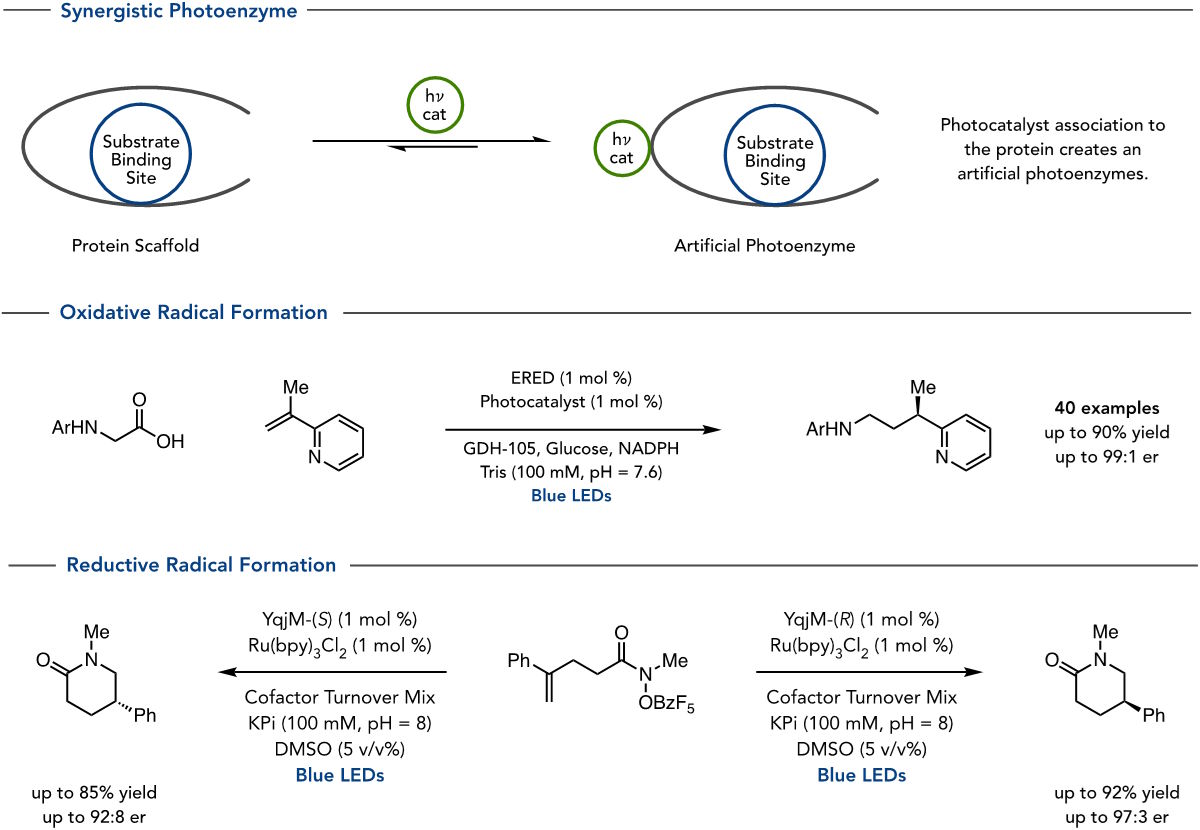
In recent decades, photoredox catalysis has garnered much attention in organic synthesis, due to their ability to access excited states that can facilitate single electron transfer reactions that are not possible from complexes in their ground state. Merging the activation mode with biocatalysis can unlock new catalytic functions for existing enzyme families. Synergistic photoenzymatic catalysis refers to photobiocatalytic systems were an enzyme and photocatalysts operate in concert to convert starting materials into products via energy or electron transfer from the photocatalyst to a substrate within the protein’s active site.1
Our group first employed a synergistic photoenzymatic system to achieve stereoselective deacetoxylation reactions by nicotinamide-dependent double bond reductases (DBRs). Close association between the enzyme and the photocatalyst, coupled with thermodynamic activation of the substrate through binding to the protein’s active site, enable the transformation in high yield and enantioselectivity.2
Following up on this study, we employed this same strategy to catalyze intramolecular and intermolecular hydroamination reactions using flavin-dependent ‘ene’-reductases (EREDs). This study showed that synergistic photoenzymatic catalysis can be used for complexity building reactions. Moreover, it revealed that EREDs can activate substrates for reduction and that common ruthenium based photocatalysts can associate adjacent to the enzymes active site. This feature opens the door to using photocatalysts with various enzymes to reveal new catalytic functions.3
In a recent study, we demonstrated that Ru(bpy)3Cl2 can be used with EREDs for oxidative radical formation, a mechanistic step that is challenging to achieve using the enzyme alone.
- Emmanuel, M. A.; Bender, S. G.; Bilodeau, C.; Carceller, J. M.; DeHovitz, J. S.; Fu, H.; Liu, Y.; Nicholls, B. T.; Ouyang, Y.; Page, C. G.; Qiao, T.; Raps, F. C.; Sorigué, D. R.; Sun, S.-Z.; Turek-Herman, J.; Ye, Y.; Rivas-Souchet, A.; Cao, J.; Hyster, T. K. Photobiocatalytic Strategies for Organic Synthesis. Chem. Rev. 2023, 123 (9), 5459–5520. https://doi.org/10.1021/acs.chemrev.2c00767.
- Biegasiewicz, K.F., Cooper, S.J., Emmanuel, M.A. et al. Catalytic promiscuity enabled by photoredox catalysis in nicotinamide-dependent oxidoreductases. Nature Chem 10, 770–775 (2018). https://doi.org/10.1038/s41557-018-0059-y
- Ye, Y., Cao, J., Oblinsky, D.G. et al. Using enzymes to tame nitrogen-centred radicals for enantioselective hydroamination. Nat. Chem. 15, 206–212 (2023). https://doi.org/10.1038/s41557-022-01083-z