


Publication Abstract
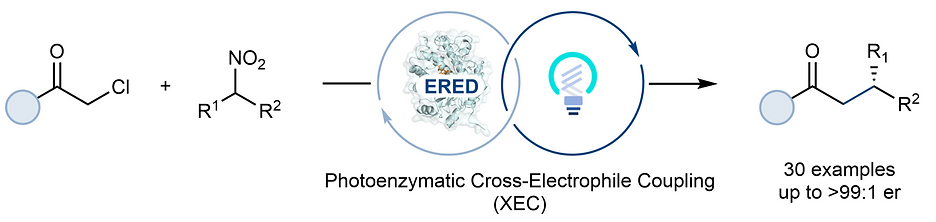
The catalytic asymmetric construction of Csp3–Csp3 bonds remains one of the foremost challenges in organic synthesis1. Metal-catalysed cross-electrophile couplings (XECs) have emerged as a powerful tool for C–C bond formation2,3,4,5. However, coupling two distinct Csp3 electrophiles with high cross-selectivity and stereoselectivity continues as an unmet challenge. Here we report a highly chemoselective and enantioselective Csp3–Csp3 XEC between alkyl halides and nitroalkanes catalysed by flavin-dependent ‘ene’-reductases (EREDs). Photoexcitation of the enzyme-templated charge-transfer complex between an alkyl halide and a flavin cofactor enables the chemoselective reduction of alkyl halide over the thermodynamically favoured nitroalkane partner. The key C–C bond-forming step occurs by means of the reaction of an alkyl radical with an in situ-generated nitronate to form a nitro radical anion that collapses to form nitrite and an alkyl radical. An enzyme-controlled hydrogen atom transfer (HAT) affords high levels of enantioselectivity. This reactivity is unknown in small-molecule catalysis and highlights the potential for enzymes to use new mechanisms to address long-standing synthetic challenges.