


J. Am. Chem. Soc. 2024, 146, 11, 7191–7197
Publication Abstract
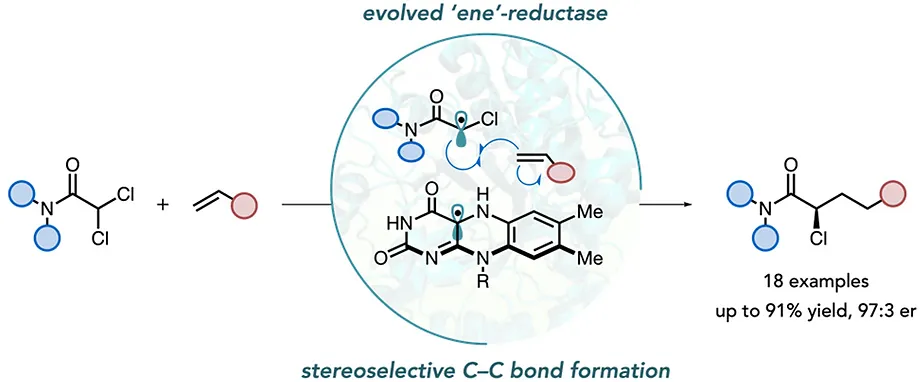
Photoenzymatic intermolecular hydroalkylations of olefins are highly enantioselective for chiral centers formed during radical termination but poorly selective for centers set in the C–C bond-forming event. Here, we report the evolution of a flavin-dependent “ene”-reductase to catalyze the coupling of α,α-dichloroamides with alkenes to afford α-chloroamides in good yield with excellent chemo- and stereoselectivity. These products can serve as linchpins in the synthesis of pharmaceutically valuable motifs. Mechanistic studies indicate that radical formation occurs by exciting a charge-transfer complex templated by the protein. Precise control over the orientation of molecules within the charge-transfer complex potentially accounts for the observed stereoselectivity. The work expands the types of motifs that can be prepared using photoenzymatic catalysis.