


Visible light photocatalysis is an immensely powerful tool for synthetic transformations, using photon-absorbing dyes or metal complexes to enable electron- and energy-transfer reactions with high-energy intermediates.
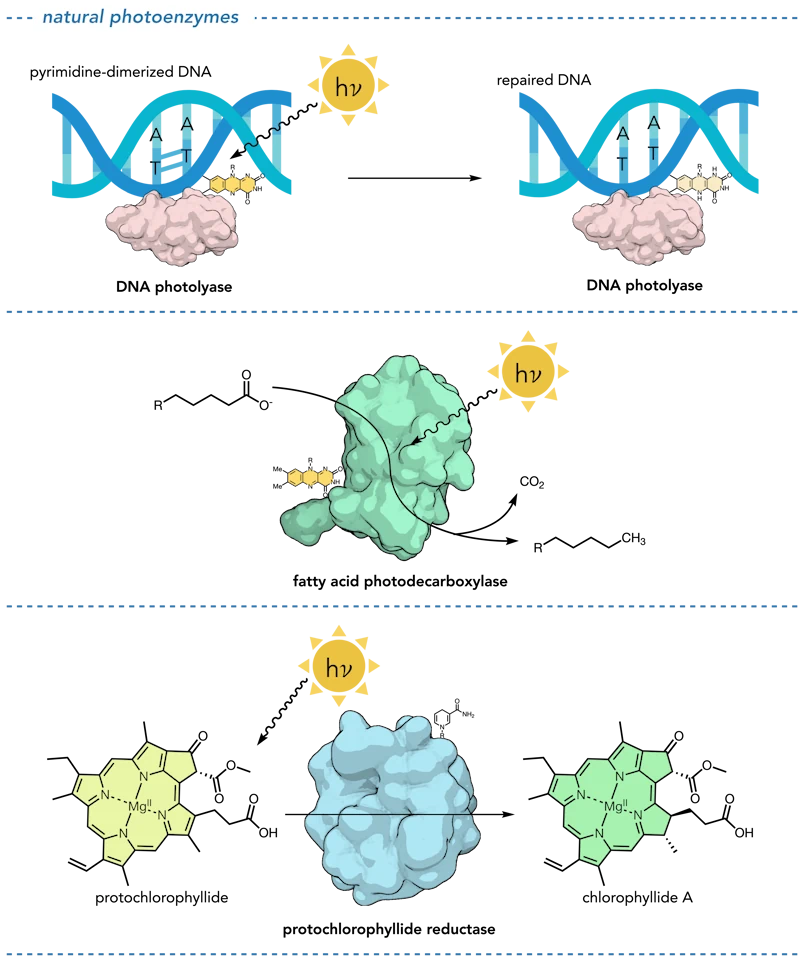
The field of photochemistry draws much of its inspiration from Nature, and especially from photosynthesis, where many proteins work in concert to store energy from sunlight. However, despite the importance of light to life on Earth, there are only three known light-dependent enzymes in Nature. These are DNA photolyase, fatty acid photodecarboxylase, and protochlorophyllide reductase.1
Enzymes have in recent years demonstrated their utility as a tool for organic chemistry, able to perform reactions with high efficiency and unparalleled selectivity under mild reaction conditions. In addition, their ability to perform reactions beyond their native scope and function can be improved with the techniques of directed evolution, making the development of new biocatalytic methods a significant area of research in both academic and industrial settings.
The Hyster lab has sought to bring the reactive capabilities of photoexcitation to biocatalysis, identifying the innate untapped photochemical functions of a variety of cofactor-dependent enzymes and harnessing them to solve problems in organic synthesis.
Charge-Transfer Complexes in Photoenzymatic Catalysis
One way in which we’ve found enzymes particularly suited to photocatalysis has been in their ability to template charge-transfer complexes within their active sites. Charge-transfer (CT) or electron-donor-acceptor (EDA) complexes occur when the molecular orbitals of two reactants overlap due to hydrogen bonding, dispersion, and dipole interactions. This interaction generates a supramolecular complex capable of being photoexcited to transfer an electron from the donor HOMO to the acceptor LUMO and form a radical-ion pair. There are a number of examples where these complexes can form in solution and be used productively; for molecules that do not generate CT complexes in solution, one might anticipate that an enzyme could template the necessary interactions instead.

Our first indication that CT states could play a powerful role in photoenzymatic chemistry came in our 2016 study seeking to leverage nicotinamide-dependent ketoreductases (KREDs) for the hydrodehalogenation of lactones.2 In this system, irradiation with blue (460 nm) LEDs was able to photoexcite an enzyme-templated CT complex between NADPH and the substrate to realize the desired transformation in good yields and high enantioselectivities.
Building upon this discovery, a similar capacity was revealed in flavin-dependent ‘ene’-reductases (EREDs) when in 2019 we used them for the stereoselective formation of lactams from chloroamides.3 In this case, optimal reactivity was observed with irradiation with cyan (495 nm) LEDs.

In later studies seeking to understand this mechanism, as well as to extend it to an intermolecular system, we would learn that the presence of the chloroamide, the alkene, and the flavin cofactor are all essential to this reactivity as participants in an enzyme-templated ternary CT complex. Since these foundational studies, we’ve observed CT state activity in a variety of systems, including the activation of simple alkyl iodides,4 functionalization of electron-rich arenes,5 and cross-electrophile coupling with nitroalkanes.6
Directed Evolution of Photoenzymes
One of the biggest strengths of enzymatic catalysis is the ability to improve and refine activity using directed evolution, and the Hyster lab has worked to develop methodology to apply these techniques to photoenzymes.7 Using robust molecular biology strategies such as error-prone, site-directed, and site-saturation mutagenesis, we develop libraries of mutated enzymes and test their ability to perform reactions using LED arrays designed for 96-well plates. High-throughput analytical methods including HPLC and RapidFire-MS enable us to assess the activity of these mutants, selecting improved variants in an iterative fashion to evolve new and more efficient photoenzymes.

For further reading, our 2023 Chemical Reviews article “Photobiocatalytic Strategies for Organic Synthesis” provides a comprehensive overview of progress made in this field as well as in related areas.
- Emmanuel, M. A.; Bender, S. G.; Bilodeau, C.; Carceller, J. M.; DeHovitz, J. S.; Fu, H.; Liu, Y.; Nicholls, B. T.; Ouyang, Y.; Page, C. G.; Qiao, T.; Raps, F. C.; Sorigué, D. R.; Sun, S.-Z.; Turek-Herman, J.; Ye, Y.; Rivas-Souchet, A.; Cao, J.; Hyster, T. K. Photobiocatalytic Strategies for Organic Synthesis. Chem. Rev. 2023, 123 (9), 5459–5520. https://doi.org/10.1021/acs.chemrev.2c00767.
- Emmanuel, M. A.; Greenberg, N. R.; Oblinsky, D. G.; Hyster, T. K. Accessing Non-Natural Reactivity by Irradiating Nicotinamide-Dependent Enzymes with Light. Nature 2016, 540 (7633), 414–417. https://doi.org/10.1038/nature20569.
- Biegasiewicz, K. F.; Cooper, S. J.; Gao, X.; Oblinsky, D. G.; Kim, J. H.; Garfinkle, S. E.; Joyce, L. A.; Sandoval, B. A.; Scholes, G. D.; Hyster, T. K. Photoexcitation of Flavoenzymes Enables a Stereoselective Radical Cyclization. Science 2019, 364 (6446), 1166–1169. https://doi.org/10.1126/science.aaw1143.
- Clayman, P. D.; Hyster, T. K. Photoenzymatic Generation of Unstabilized Alkyl Radicals: An Asymmetric Reductive Cyclization. J. Am. Chem. Soc. 2020, 142 (37), 15673–15677. https://doi.org/10.1021/jacs.0c07918.
- Page, C. G.; Cao, J.; Oblinsky, D. G.; MacMillan, S. N.; Dahagam, S.; Lloyd, R. M.; Charnock, S. J.; Scholes, G. D.; Hyster, T. K. Regioselective Radical Alkylation of Arenes Using Evolved Photoenzymes. J. Am. Chem. Soc. 2023. https://doi.org/10.1021/jacs.3c03607.
- Fu, H.; Cao, J.; Qiao, T.; Qi, Y.; Charnock, S. J.; Garfinkle, S.; Hyster, T. K. An Asymmetric Sp3–Sp3 Cross-Electrophile Coupling Using ‘Ene’-Reductases. Nature 2022, 610 (7931), 302–307. https://doi.org/10.1038/s41586-022-05167-1.
- Nicholls, B. T.; Oblinsky, D. G.; Kurtoic, S. I.; Grosheva, D.; Ye, Y.; Scholes, G. D.; Hyster, T. K. Engineering a Non-Natural Photoenzyme for Improved Photon Efficiency**. Angewandte Chemie International Edition 2022, 61 (2), e202113842. https://doi.org/10.1002/anie.202113842.